Selection Guides
Piston vs Screw Compressors for Cold Storage
Piston and screw compressors both come from BITZER, but they fit different rooms. Piston covers small to medium loads down to -50°C; screw takes over where the load gets large.
Piston and screw compressors both come from BITZER, and both appear in the same catalog — but they fit different rooms. Piston machines cover small to medium loads, from 2,960 W up to 124,600 W in a single unit, and down to -50°C with the two-stage KLDPL. Screw machines take over where the load gets large: a single screw unit runs from 97,100 W to 340,600 W at 0°C, and down to -45°C on the low-temperature side. The choice is decided by two numbers — the cooling load and the evaporating temperature — not by which machine looks more modern. This guide is for cold storage contractors and refrigeration buyers choosing the compressor type for a new room. It will not help you if the load is already fixed by an existing plant — then the question is the model, not the type.
The room that outgrew its compressor
A distributor called about a cold store that had grown. The original room ran on a piston unit and worked well for years. Then the owner added a second room, then a freezing tunnel, and the load roughly tripled. The distributor's first instinct was to order a bigger piston unit — the largest one in the catalog — and it would have worked, just barely, at the edge of its range. The second instinct was to jump to a screw unit, which would have covered the load with room to spare but needed a bigger plant room, a separate condenser, and a budget the owner had not approved. Both instincts were reasonable. Both were also wrong in the same way: they started from the machine instead of the load.
That is the normal shape of this decision. Piston and screw are not rivals; they are neighbours with a boundary between them, and the boundary is a number. Below it, the piston machine is smaller, simpler and cheaper to install. Above it, the screw machine is the only single unit that covers the load, and the piston answer would be a parallel rack of two or three machines instead. The buyer who does not know where the boundary sits ends up either undersizing — a piston unit running at its limit in August — or oversizing — a screw unit installed for a load a piston machine would have carried. Both cost money, and both are avoidable before ordering.
Why the catalog lists both, and what each one is
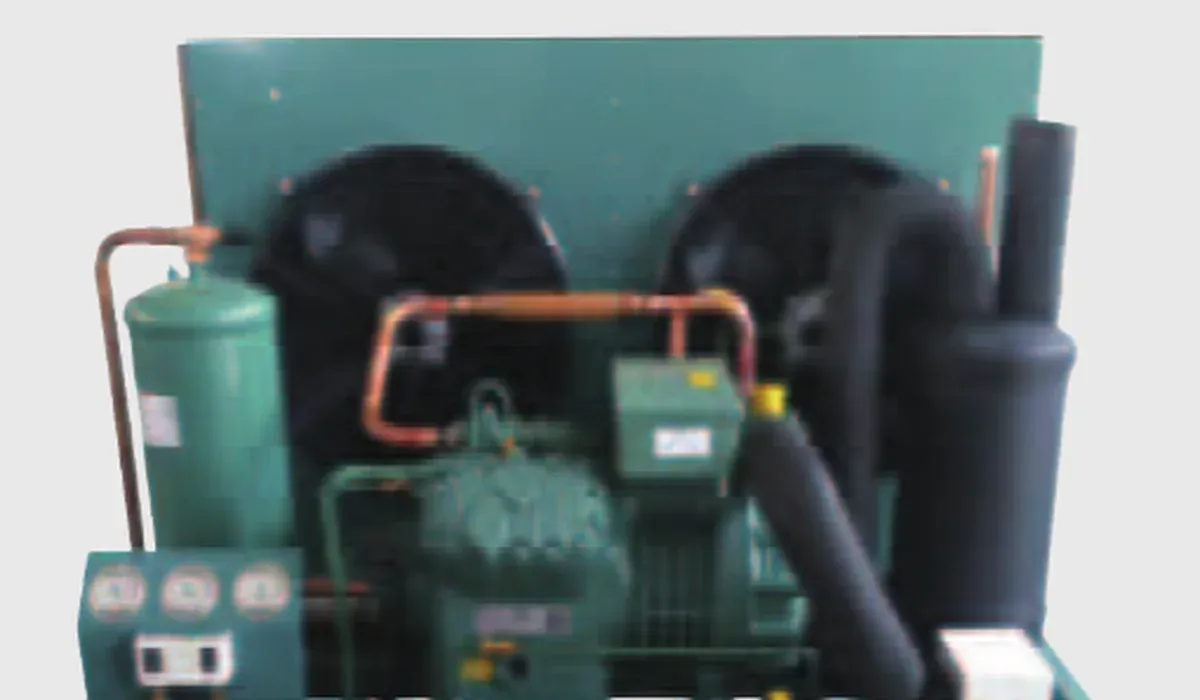
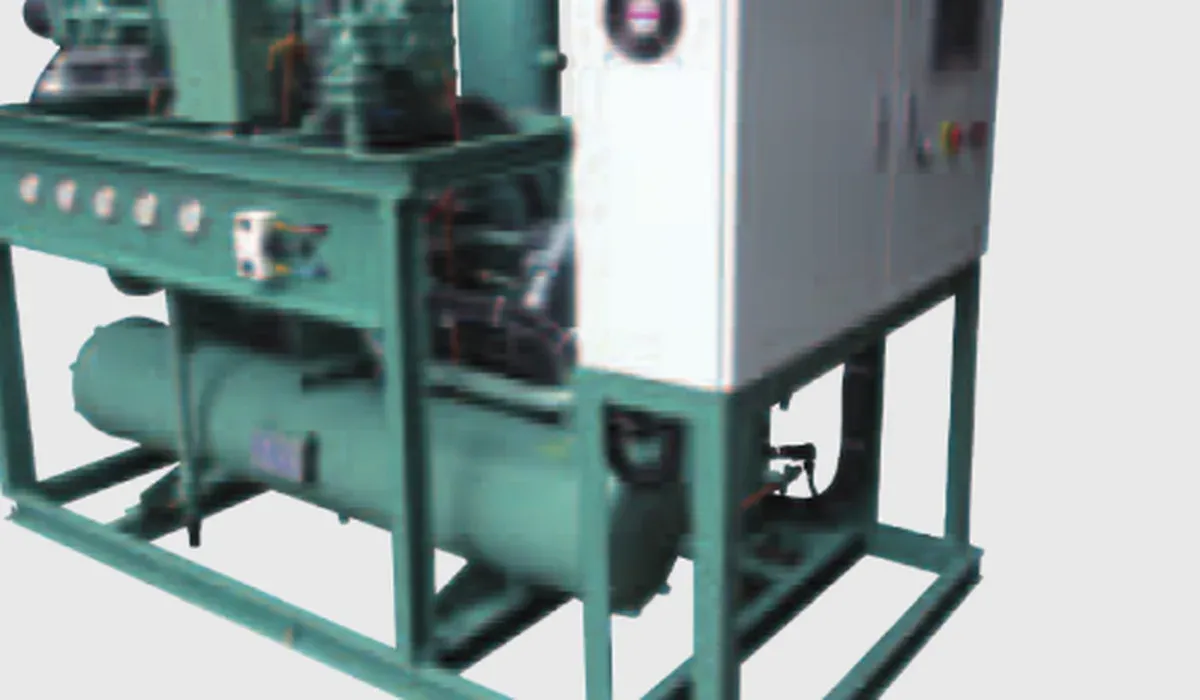
Start with what the catalog does say, because the two families are described in the same terms. The piston series — KLPH, KLPL and the two-stage KLDPL — is built on the original German BITZER semi-hermetic piston compressor, with a full-size condenser, small vibration, low noise, a compact structure and high reliability. The single-stage piston range runs from the smallest KLPH model at 2,960 W at 0°C on R22 up to the 6FE-50 at 124,600 W, covering evaporating temperatures from 12.5°C down to -40°C across the KLPH and KLPL series, and the two-stage KLDPL continues to -50°C. The screw series — HSK and HSN — is built on the original German BITZER semi-hermetic screw compressor. Its features are different in kind, not just in degree: no suction or discharge valve plates, which means less vibration and gas pulsation and higher system efficiency; fewer internal moving parts, which means high reliability, long life and less maintenance; and at low temperatures an economizer, which means high efficiency and low running cost. The catalog's own summary is that screw units are especially suitable where a large cooling capacity is required.
The numbers draw the boundary. The smallest screw model, the HSK5363-40, delivers 97,100 W at 0°C on R22 — roughly where the largest single piston unit ends — and the largest screw model, the HSK8571-140, delivers 340,600 W at the same temperature. On the low-temperature side the HSN5353-25 delivers 33,600 W at -25°C, and the HSN range runs to -45°C. There is one more difference that matters more than any capacity figure: the screw unit is supplied without a condenser. It is built for evaporative cooling or air-cooled condensation, and the condenser is a separate decision. The piston unit arrives complete, condenser included. That single fact changes the installation, the plant room, and the quote.
The evidence gap is the load itself. Most buyers choosing between piston and screw do not have a calculated cooling load — they have a room size, a product, and a target temperature, and they are guessing the load from experience. That guess is usually good enough to choose a piston model, because the piston range is wide and forgiving. It is not good enough to choose a screw machine, because the screw range starts where the piston range ends, and a load guessed 30% too high can push a buyer across the boundary into a machine three times the size they need. Get the load calculated, even roughly, before choosing the type.
The decision, in two numbers
Take the cooling load first. If the load at the room's evaporating temperature is below roughly 100 kW, a piston unit covers it — single units run to 124,600 W at 0°C, and parallel racks of two or three piston compressors run to 249,200 W and 373,800 W. If the load is above roughly 100 kW in a single machine, the screw series is the direct answer: one HSK5363-40 covers what would otherwise need a parallel rack, with fewer machines to maintain. The word roughly matters, because the boundary moves with temperature: at -25°C the largest piston single gives 46,350 W, while the smallest screw low-temperature model gives 33,600 W — the two families overlap at deep temperatures, and the choice there depends on the exact load and the room, not on a round number.
Then take the evaporating temperature. For rooms down to -40°C, the piston series covers everything: KLPH to -25°C, KLPL to -40°C. For rooms below -40°C, the two-stage piston KLDPL covers -20°C to -50°C, and the screw HSN covers -15°C to -45°C — the two overlap between -40°C and -45°C, and the load decides between them. A small blast freezer at -45°C is a KLDPL job; a large frozen store at -40°C is an HSN job. The temperature does not choose the type on its own; it narrows the field, and the load finishes the choice.
Different buyers land in different places. A cold storage contractor building a single frozen room will usually land on piston: the unit is complete, the install is self-contained, and the range is wide enough. A food-processing plant with a large central load will often land on screw: one machine, one control system, and the economizer paying back at low temperatures. A distributor stocking for resale should stock the type the local installers ask for — and should know that the screw unit needs a condenser decision attached to every quote, or the customer will come back asking where the condenser is.
What can go wrong, and what this guide does not cover
Four mistakes account for most of the trouble. The first is choosing by size alone — ordering the biggest piston unit because the load "feels large", without calculating it, and ending up with a machine running at its limit. The second is the opposite: ordering a screw unit for a 40 kW load because screw sounds more industrial, and paying for a machine, a plant room and a separate condenser that a piston unit would have made unnecessary. The third is forgetting the condenser: the screw unit arrives without one, and a buyer who priced only the unit discovers the condenser during installation. The fourth is treating catalog figures as guarantees. The catalog says so itself: sample data is for reference only, designs may change without notice, and detailed specifications are fixed in the contract. Use the tables to shortlist, not to promise.
There are also boundaries this guide does not cross. It does not cover parallel units in detail — the KLB2/KLB3 racks, which are the third answer when the load exceeds a single piston unit but the buyer wants to stay with piston machines. It does not cover box units or two-stage water-cooled variants. And it does not give prices, lead times or certifications, because the catalog gives none, and this guide invents nothing. If a supplier quotes a running cost or an efficiency figure, ask for the conditions it was measured under before you compare it with anything.
Your next step
Get two numbers and write them down. One: the cooling load at the room's evaporating temperature — calculated, not guessed, even if the calculation is rough. Two: the evaporating temperature itself. If the load is below roughly 100 kW, look at the piston series — KLPH, KLPL, or the two-stage KLDPL for deep cold — and check whether a single unit or a parallel rack fits. If the load is above it, look at the screw series — HSK for medium/high temperatures, HSN for low temperatures — and remember the condenser is a separate decision. Then send the load and the temperature through the inquiry form, and ask for the matching model with a quotation. Do the load calculation first; the type choice takes minutes once the numbers are known, and it takes weeks to undo if the type was wrong.